

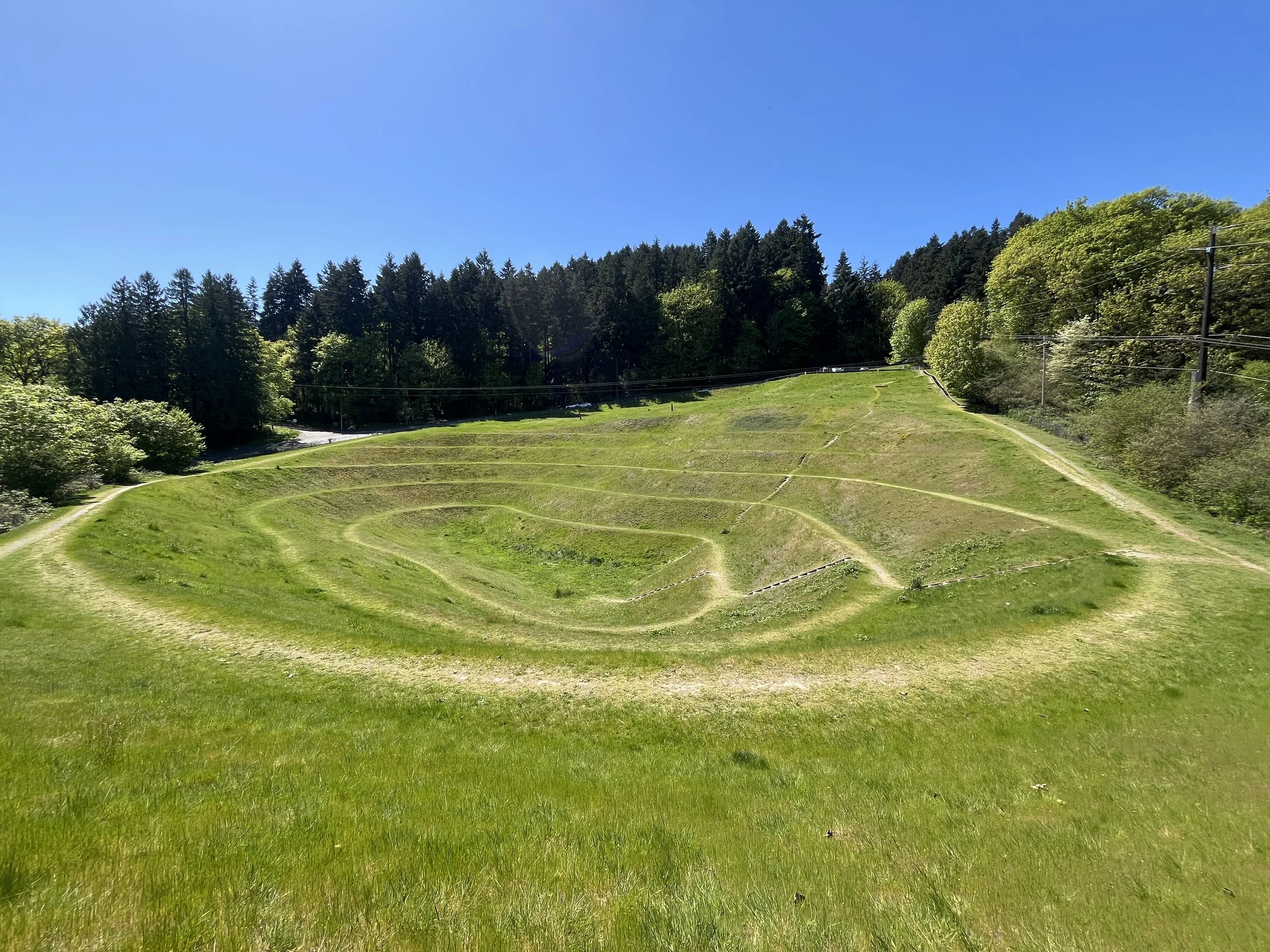
Robert Morris, Johnson Pit #30, 1979
SeaTac, Washington
April, 2026
Background
I’m going to directly plagiarize from this website, which I felt had a perfect summary and background of the installation.
Johnson Pit #30 is a 3.7 acre site on a hillside, a former gravel pit was reclaimed, consisting of a series of concentric slopes planted with rye grass. It was designed by Robert Morris and completed in November 1979. At the top there were some blackened tree stumps to represent a ghost forest to remember the nature that was decimated for the pit. It was renovated in 1994 after it fended off attempts to convert it to a more traditional public space, they added fir steps to avoid the erosion of people climbing up and down the slopes (it should be noted that most people, including myself, walked up and down the slopes regardless). They also added benches and replaced the stumps with just posts. It was built for ~$120,000 (~$500k in 2026) and renovation costs were ~$50,000 ($100k in 2026).
In 1970s, the Department of Public Works of Kings County, Washington had more than 100 gravel pits that had been created to supply the 20th century infrastructure expansion for the Pacific Northwest. Basically, once the roads were built, gravel was less necessary and often the pits themselves were depleted, so reclaiming them for other purposes became the goal. Most were sold to private developers and were filled in and built over, many became municipal landfills eventually capped with grass, some were fenced off and reforested naturally, but two became land art.
In 1978, the Kings County Arts Commission collaborated with the group and held a symposium titled Earthworks: Land Reclamation as Sculpture. 22 artists were invite to submit proposals, 11 submitted, 8 were featured at the event, and two were selected to be the demonstrations of the concept. Funding, constraints, maintenance liability, and political pushback all limited the application. But we ended up with two of them. There is Mill Creek Canyon in nearby Kent, and this one in SeaTac. This one was done in pit #30 hence the name.
This website does a great job of showing the development, timeline, and history. They also have great resources of the other participants’ and their proposals as well, very cool to peruse. They’ve collected images of the models and videos of the artists at the respective sites which is pretty cool.
Travel
Johnson Pit #30 is technically in the city of SeaTac, which I didn’t realize was a real city. I thought it was a portmanteau nickname for the area of/between Seattle and Tacoma. It’s main acclaim to fame is that the airport for the region is here and called that. The earthwork is on its southern edge and is actually pretty accessible via public transportation (25-35 minutes), you could take the A line bus to Pacific Hwy S & S 216th St or the 161 Bus to S 212th St & 42nd Ave S, but either way you’ll have to walk a few minutes to get to your final destination. Or a 10-15 minute drive is probably a bit easier.
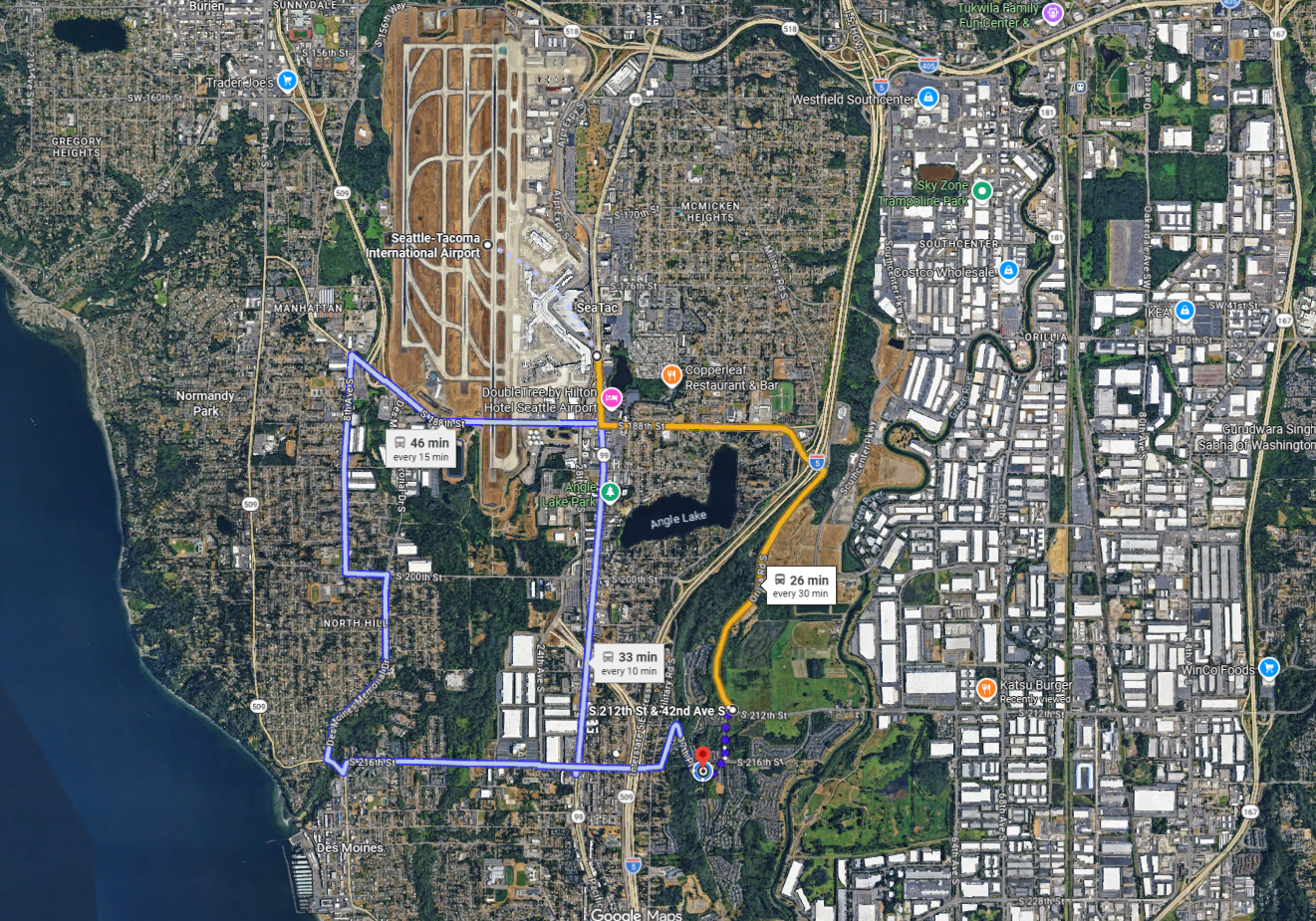
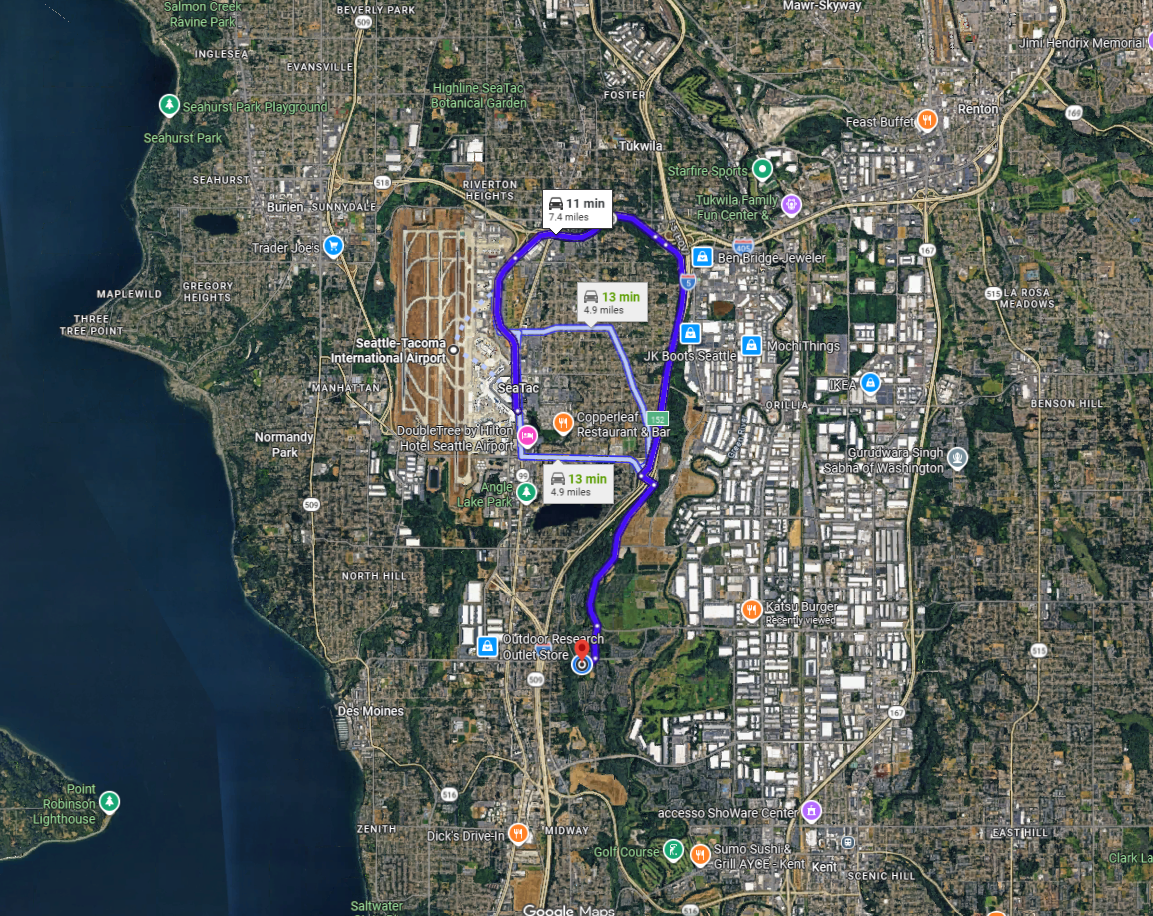
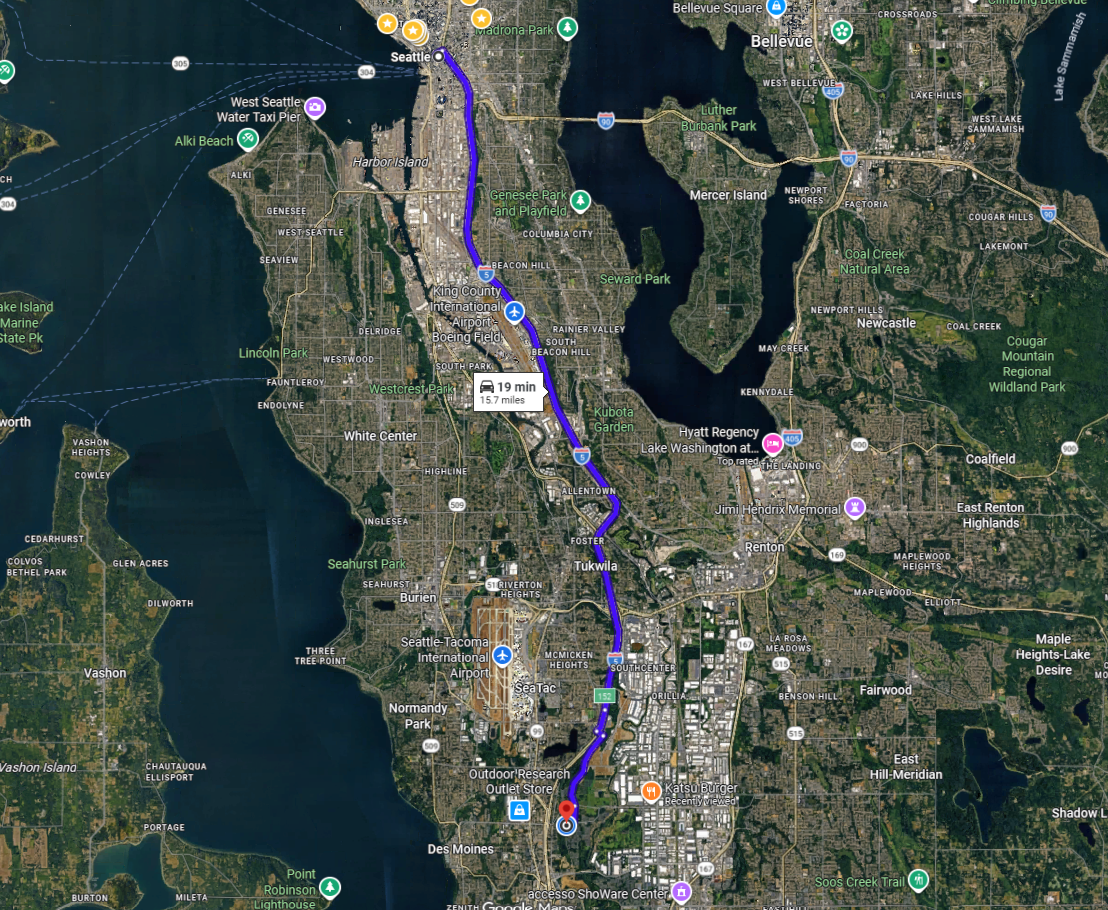
You’re most likely going to be coming from Seattle, and it’s a 20 minute drive (without traffic) off of the I5. I’m sure there would be a bit more traffic typically.
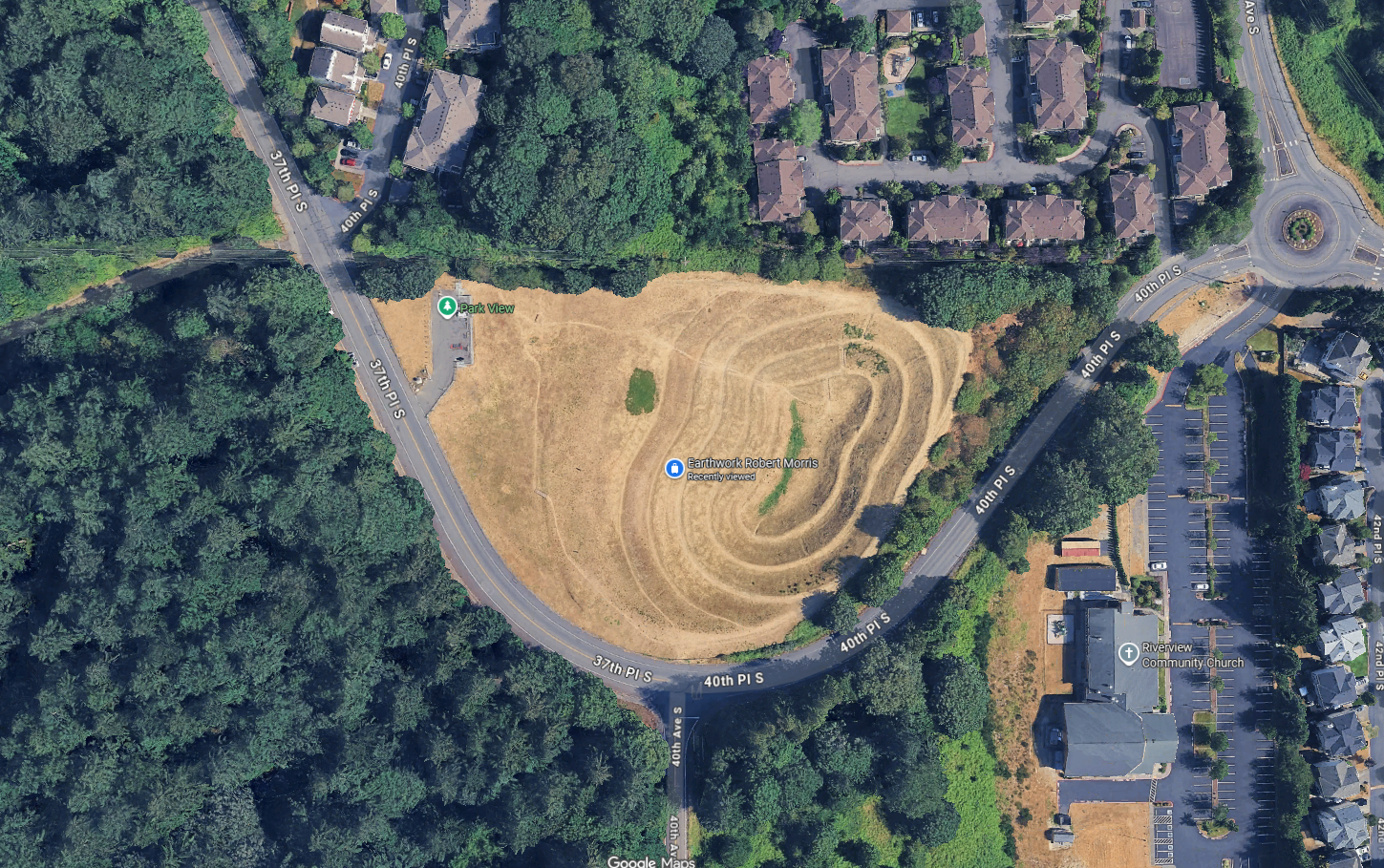
It sits within a mostly residential area and there’s a little parking lot for around 6 vehicles for access. There were also cars randomly parked on the street, but it was unclear if it was legal or even where those people even were.
There are no facilities here. There is an informational plaque and a stone wayfinding sign, but that’s about it. There are residential complexes nearby, but nothing really else. It is suburban Washington, so there’s food and restrooms available on the main stretches, a few minutes away. It is entirely free to visit and there are no hours of operation posted, so I assume you just follow sunlight. But I imagine many a teen has had drinks at the bottom with friends. Probably a rite of passage.
Experience
We arrived around 1 pm on a Sunday in April, on my way back to SeaTac for my flight home. It’s a short drive to the airport from the Johnson Pit #30, so we figured it would be an easy stop. We left around 2 pm, there were probably around 6 vehicles that stopped by at some point. There was a family of 4 and their dogs and they were having a grand old time. Dogs were bouncing around with boundless energy, going up and down and zig zagging throughout. After they left, we saw a couple more people with dogs come through, and a few suspicious vehicles just park at the lot and just loiter for a bit before leaving.
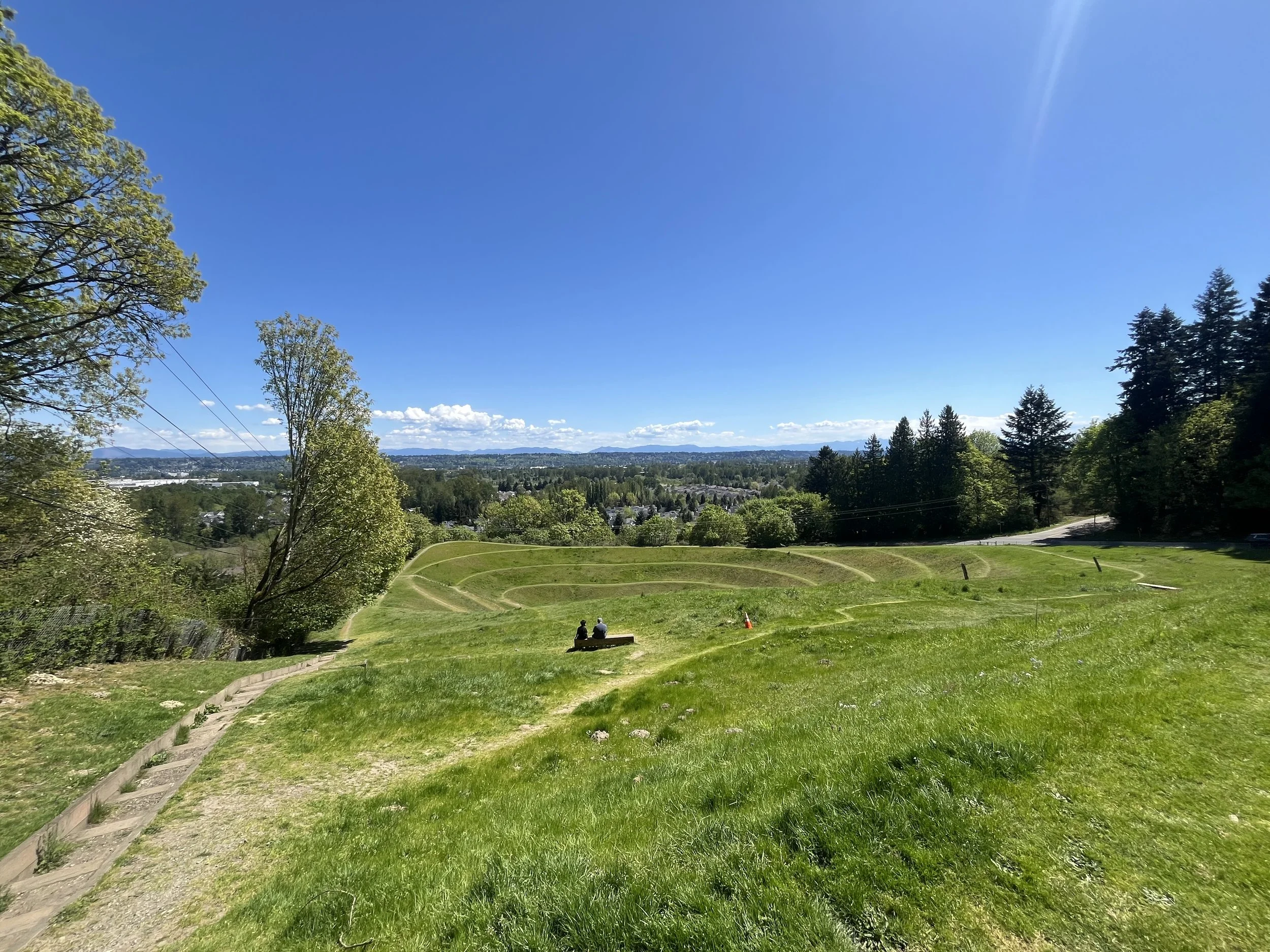
The Pacific Northwest on a beautiful day is really just better than most places. It was warm and pleasant, with clear views from the top of the earthwork to the Cascades in the east, we’re even able to see the Snoqualmie pass. But most impressively was the pretty clear view to Mt. Rainier. Seattle doesn’t really have a shortage of green space, certainly not outside the downtown, but this little park nestled into the hill is a real steal for some of the locals. Certainly a great “natural” spot to let kids or dogs loose in, the locals on 40th Pl S must enjoy picnicking out there on a nice day. I’m curious how it would be on a rainy day. Does the water get soaked up by the soil or does it stream down into the lowest bowl and start pooling up? I didn’t take not of it at the time, but I hope there is a good runoff system from the road to prevent the pit from flooding and eroding further.
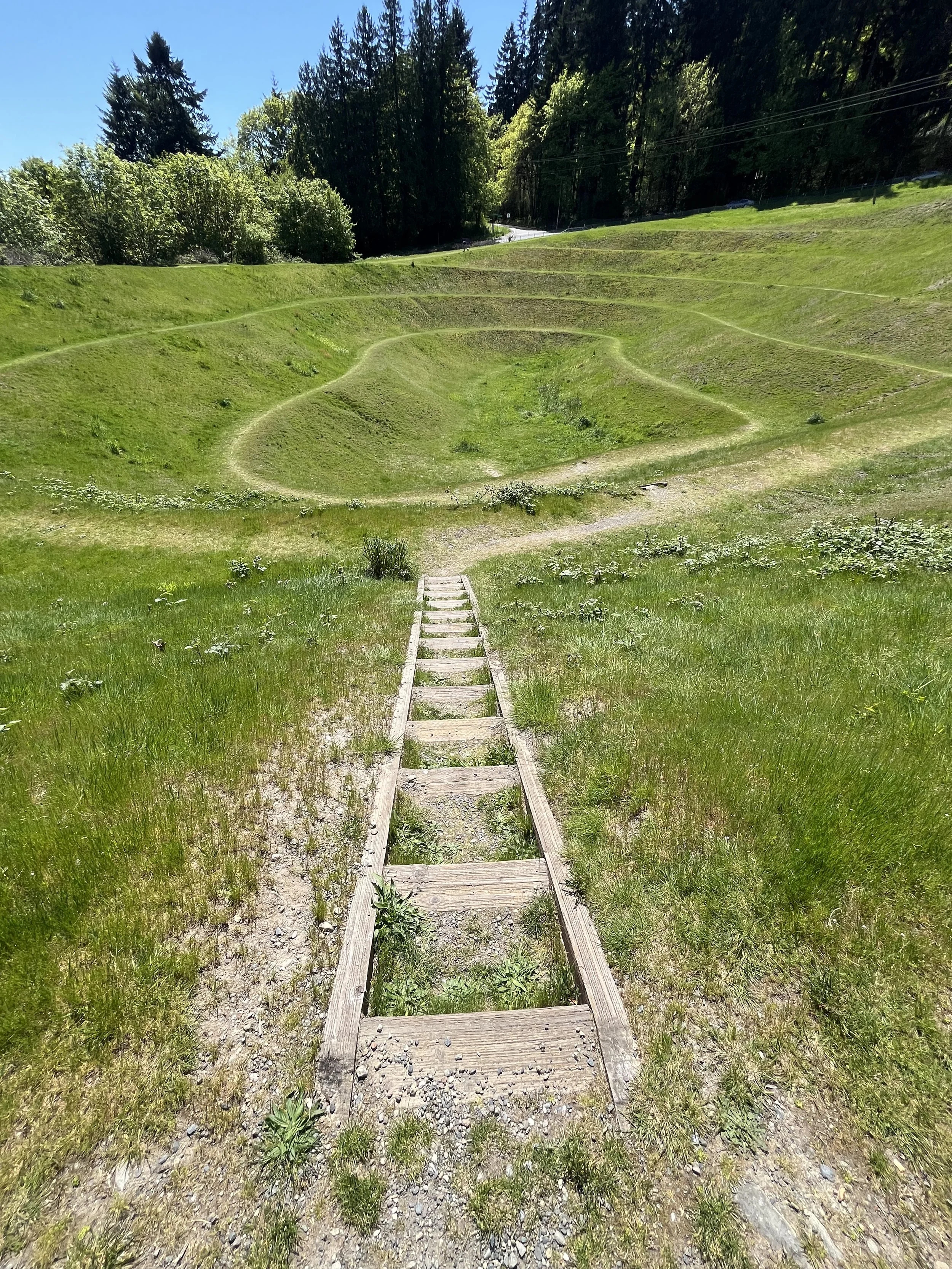
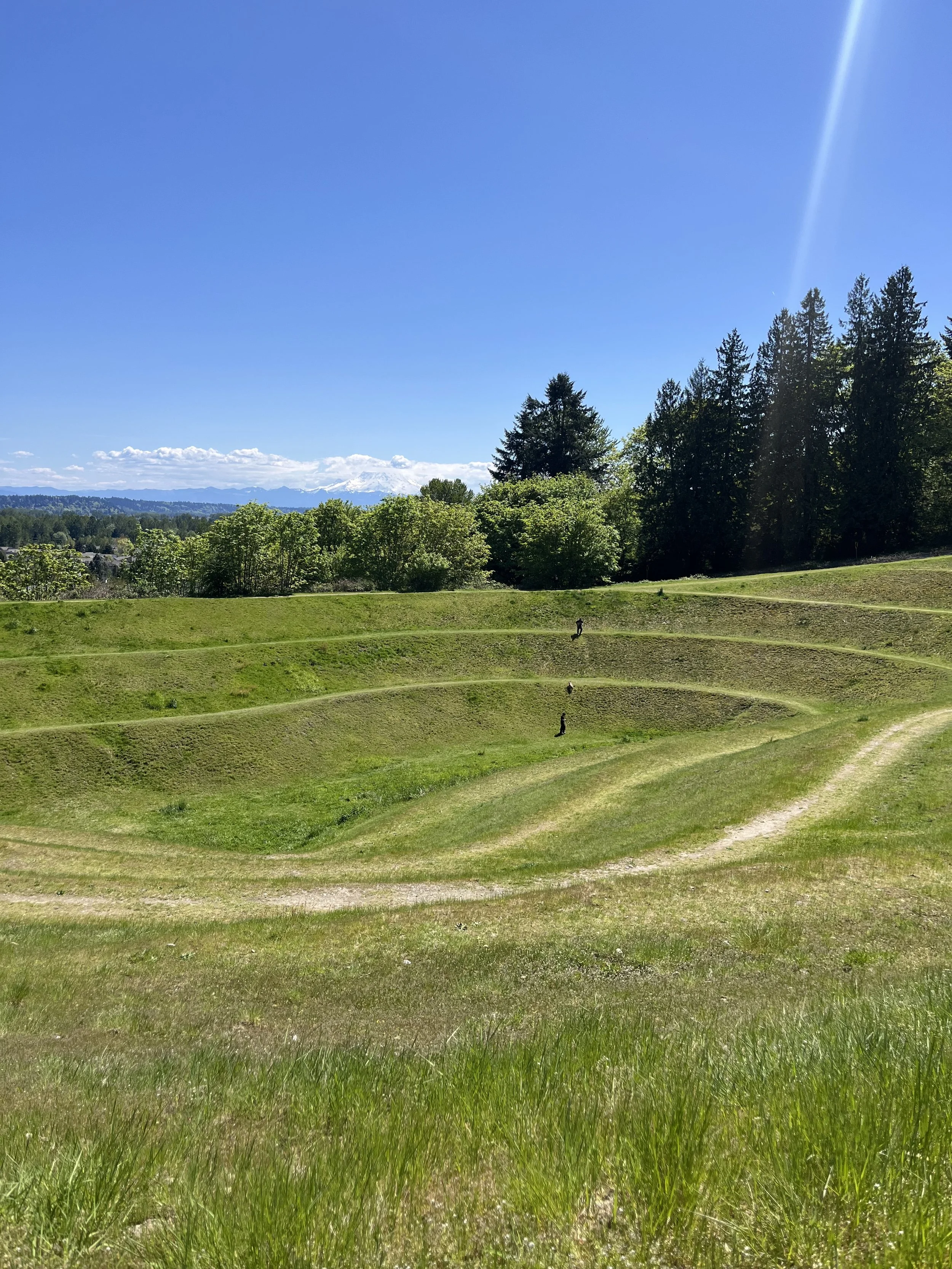
I sat at the top for awhile, then under the overgrown trees to grab some shade. I wish we had food and drinks, it would have been a perfect spot for lunch. When you’re at the bottom, you really can’t see the cars in the lot which is nice. A feeling of isolation and nature despite it being pretty suburban and small. I didn’t really get a sense of the gritty history, but I did enjoy the design of the space greatly. We both suggested that they do some performance art here. It’s a natural amphitheater. Would be pretty cool for a pop up concert or a play of some sort. People would site on the ridges fully encapsulating the “stage”. Though parking would probably be a bit of a nightmare (there is a church down the hill that has extra parking).

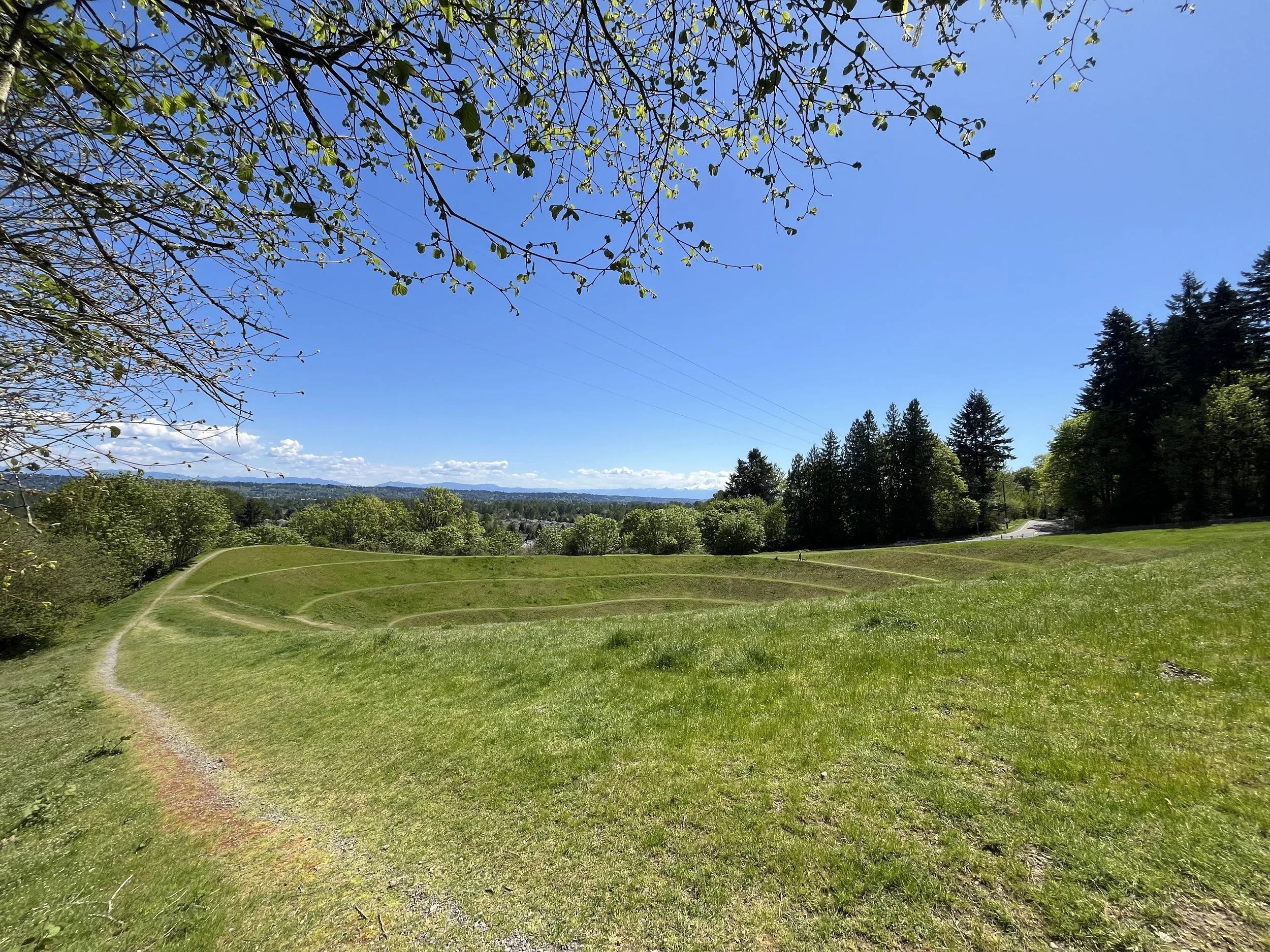
Reviewing some of these pictures, I’m surprised I didn’t notice the powerlines crossing overhead, at a pretty far length too. The earthwork is a very successful reclamation of an industrial site, into a public asset. It definitely feels like something that wouldn’t / couldn’t be made today. Too abstract, too expensive, and not programmed high enough. But it’s still a great park.

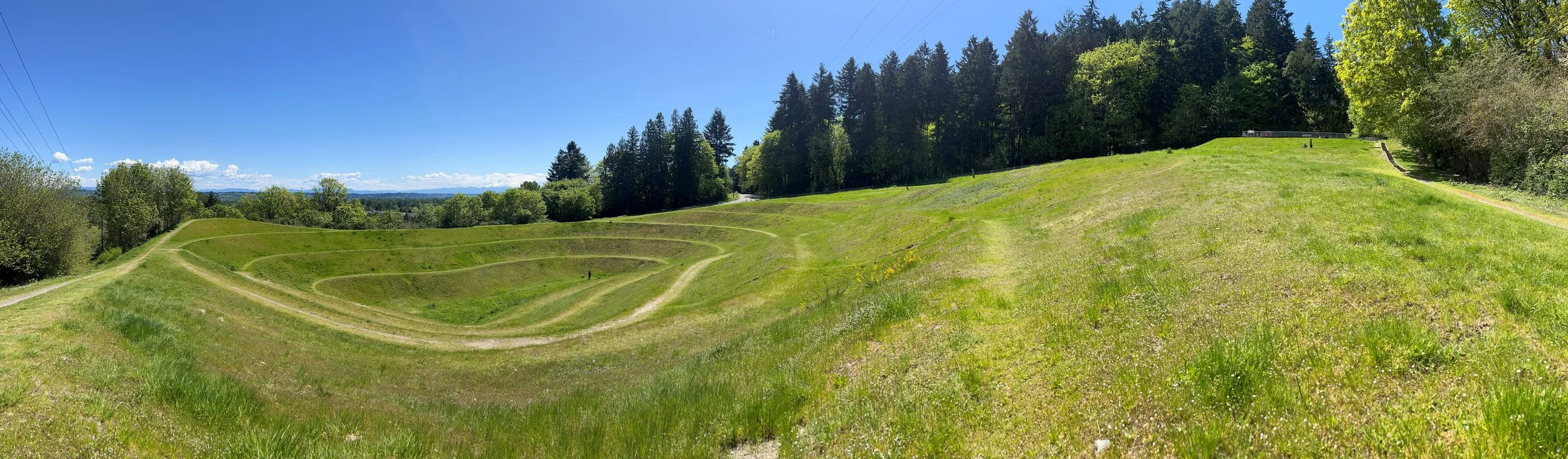
I was honestly a bit surprised it hasn’t been maintained and renovated since the 1990s. Over 30 years as is, it still looks like it’s in really good shape. Sure, it could use some landscaping, lots of weeds, and inconsistent growth, but people stayed on trail for the most part. There felt like a decent enough amount of respect for it. Perhaps that’s just Washingtonian culture, but there wasn’t any trash throughout it, though there was some caught over the ridge by the fencing to the nearest housing development. The space was clearly free flowing enough with plenty of desire paths throughout, that I didn’t feel too bad doing a fun panorama cloning. My friend was in the base and I ran around the ridges going from level to level. There are unfortunately only 6 of me in the photo, but there should have been 8. One of the ones I’m missing is Mattos’ power pose!
Now finding out there’s another one in Kent I have to see, that’ll be for next time I’m in the area, though I wish I had done my research first (as per usual) and done the double header.
Summary
On a beautiful day in the PNW, the Johnson Pit #30 is a conveniently located park near the airport that is totally worth visiting. That said… on a beautiful day in the PNW, basically anywhere in nature is totally worth it. It’s still a wonderful concept and is great for locals to utilize for a very casual stroll with great views (including of Mt. Rainier).
Sources
4Culture. “Untitled (Johnson Pit #30).” Public Art. Accessed May 10, 2026. https://www.4culture.org/public_art/earthwork/.
Artnet News. “A Guide to the Most Iconic Land Art Across the United States.” Art World. May 13, 2024. https://news.artnet.com/art-world/land-art-united-states-2483830.
Atlas Obscura. “Untitled (Johnson Pit #30).” Accessed May 10, 2026. https://www.atlasobscura.com/places/untitled-johnson-pit-30.
Bytes and Boxes. “King County Earthworks: Land Reclamation as Sculpture.” King County Archives. Accessed May 10, 2026. https://bytesandboxes.org/king-county-earthworks-land-reclamation-as-sculpture/.
The Cultural Landscape Foundation. “Robert Morris Earthwork (Johnson Pit #30).” Landslide: Art and the Landscape. Accessed May 10, 2026. https://www.tclf.org/sites/default/files/microsites/art-landscape/morris-earthwork.html.
Morton, Ella. “Washington State’s ‘Untitled (Johnson Pit #30)’ Is a Big Grassy Pit, but It’s Also Land Art.” Slate, August 5, 2015. https://www.slate.com/blogs/atlas_obscura/2015/08/05/washington_state_s_untitled_johnson_pit_30_is_a_big_grassy_pit_but_it_s.html.
Seattle Southside Regional Tourism Authority. “Robert Morris Earthwork (Johnson Pit #30).” Accessed May 10, 2026. https://www.seattlesouthside.com/directory/robert-morris-earthwork-johnson-pit-30/.
Walk · Listen · Create. “Untitled Earthwork (Johnson Pit #30).” Accessed May 10, 2026. https://walklistencreate.org/walkingpiece/untitled-earthwork-johnson-pit-30/.
Wikipedia. “Robert Morris Earthwork.” Last modified March 14, 2024. https://en.wikipedia.org/wiki/Robert_Morris_Earthwork.