

A Year of Fliff
Skip To
Fliff’s mechanics work basically with three in-app currencies: Fliff Cash, Fliff Coins, and Experience Points. The usage of these currencies somehow allows the app to avoid being considered gambling.
Without a doubt sports gambling is bad for our society and should be made illegal again.
Last Week Tonight with John Oliver Season 12 Episode 5
Honestly, I’ve watched probably all of the Last Week Tonight with John Oliver episodes. This one premiered on March 16, 2025 and let’s assume I watched it the day after and downloaded the suspicious app Fliff after it was featured. The long and the short of it is that this pretty terrible app is part of the wider awful sports betting ecosystem by targeting teenagers. It is technically legal because it uses in app currencies (Fliff Coins and Fliff Cash), falling under a sweepstakes model that allows them to offer it to those under 21. Watch the episode below.
Well, as someone who views sports gambling as a dangerous vice and think it should be illegal, but as wants to be personally responsible, I found Fliff to be intriguing. It could fit my use case, as someone who watches sports and may want to make wagers to add weight and feel the success of correct predictions, with potential rewards. I would simply not succumb to the pressure to add any real money or purchase anything from the app (easier for me as someone in their mid-thirties who already has a mostly developed brain). While this may not have been (almost certainly was not) John Oliver’s intent, I downloaded the app and gave it a shot.
It’s now almost one year later and I wanted to give people an honest review, story, and verdict on Fliff and sports gambling.
First Experience in 2022
Let’s start with a brief review of my first bout with app based sports gambling. In the spring of 2022 I downloaded 7 apps and took their introductory offers and only made arbitrage bets where I would have zero risk. These seven apps were: FanDuel, PointsBet, ResortsWorld, BetMGM, Caesars, Bet Rivers, and WynnBets.
So basically I took their introductory offers which came with free bets or some amount of money locked up (requiring a bet), and I would find a game that had different odds on the apps, and then bet on the game making sure that regardless of the result I would win money. For example one app may offer +120 for the Knicks to beat the Nets and another app +115 for the Nets to beat the Knicks. Betting on both guarantees a profit since if either result occurs then you’ll win. So if you bet $100 on the Knicks and they won you would get $220 and if you bet $100 on the Nets and they won, you would get $215. These two bets guarantee a return of $15-20. The next level is to maximize the guaranteed returns with the same stake (of $200), so actually betting $98.85 on the Knicks and $101.15 on the Nets will guarantee $16.32 regardless of who wins.
While less exciting than actual sports betting, it was a great way to take introductory money from the sports apps. I found it quite fun to try and find these opportunities. That said, apparently if you do this enough, you’ll get banned from the apps, but I didn’t do it for that long as I was mostly interested in just taking their introductory offers ranging from $100 to $1,000 in free bets / bonuses / etc. There were all sorts of weird schemes and limitations, so you really have to read the fine print, and I definitely didn’t do it perfectly, but I had a good time trying.
Between 3/29/22 and 4/24/22 I made 24 bets and earned $1,380.43. I had to wager $3,549.62 to earn $4,930.05. A ~39% return. (Definitely part of the March Madness marketing push) I deleted the apps and walked away with my winnings (and paid my taxes).

Fliff Mechanics
Fliff’s betting odds were almost 100% worse than every sportsbook out there whenever I went to compare it. You would never be able to do any arbitrage with this app because it always paid less for either side of any game. I suppose it means they’re taking a larger vig (or the house margin) than other apps, which is smarter from a business sense, especially since their target consumer isn’t a more intelligent gambler who wants better odds, but a teenager who isn’t allowed to gamble on actual sportsbooks.
Fliff has three in app currencies:
Fliff Cash
This is the most straight forward, it’s just money. You can add money to your account and gamble like any sports app. Sometimes you’re given promotional amounts throughout. I gained like $5 just for joining, subject to playthrough (meaning you have to bet it to be able to withdraw it).
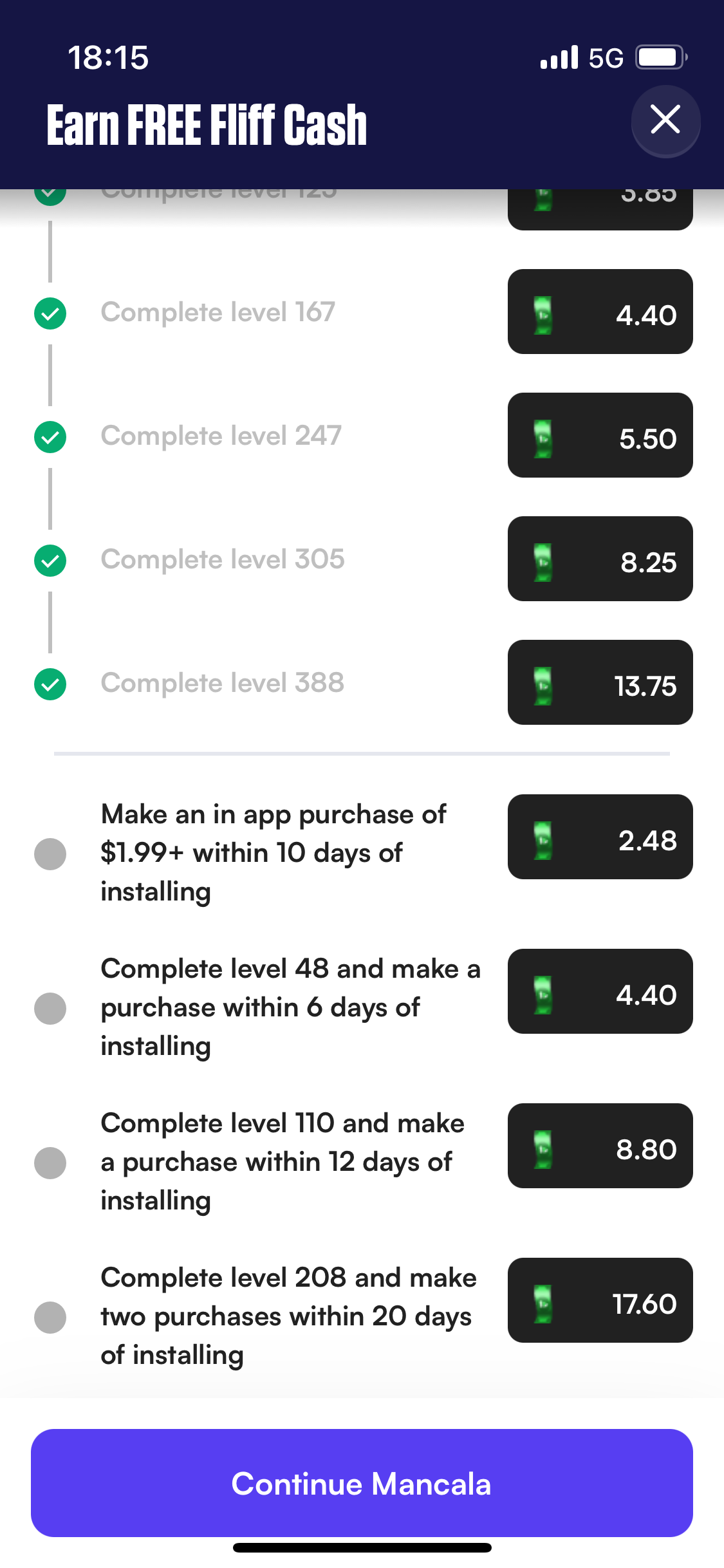
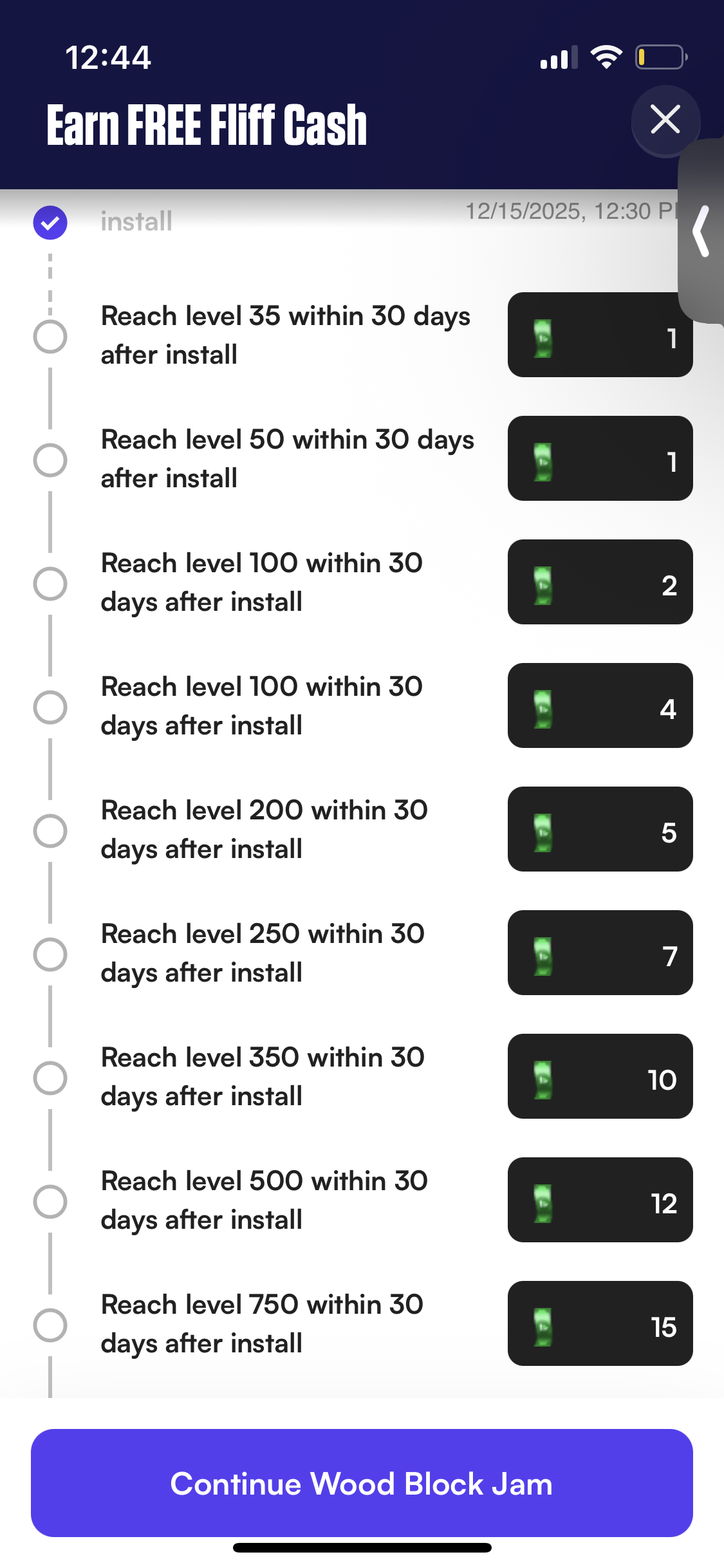
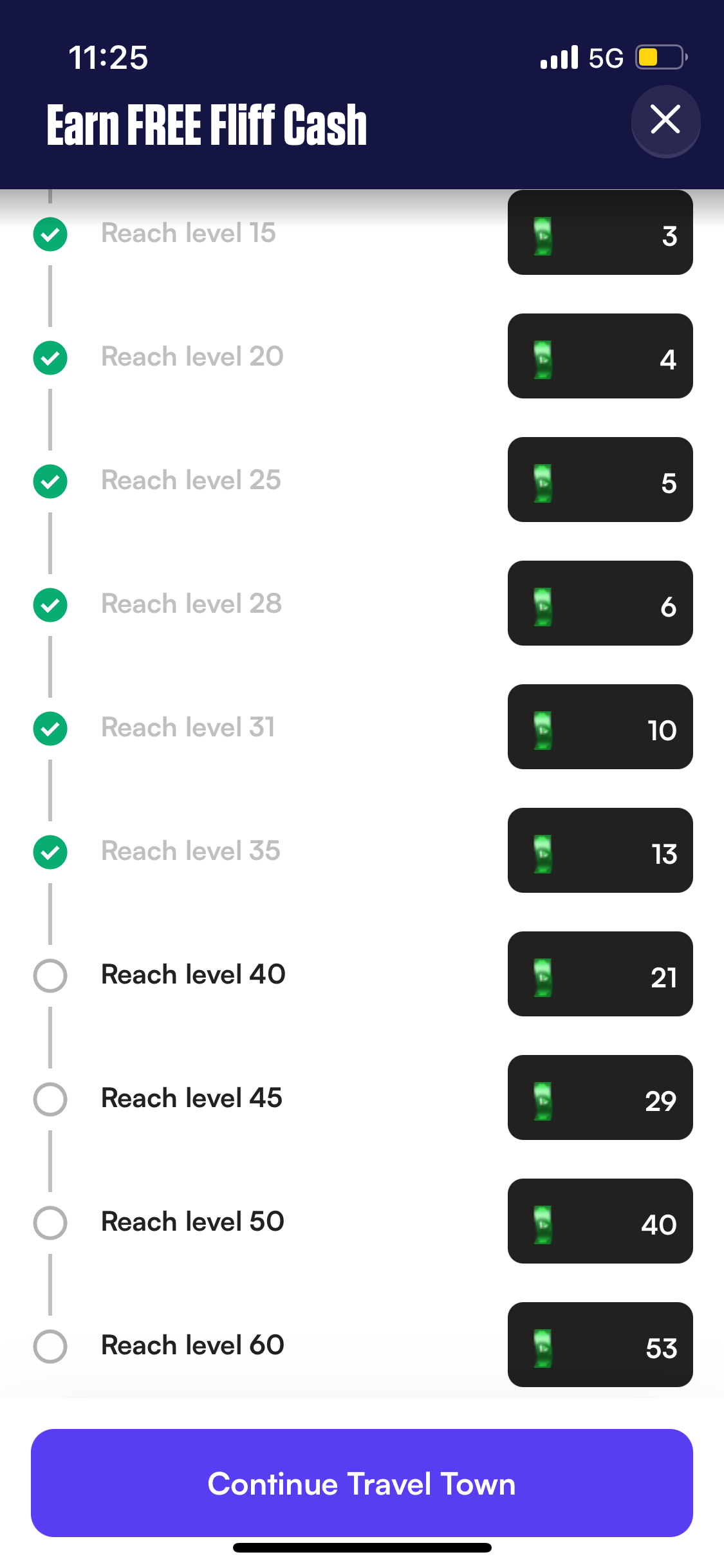
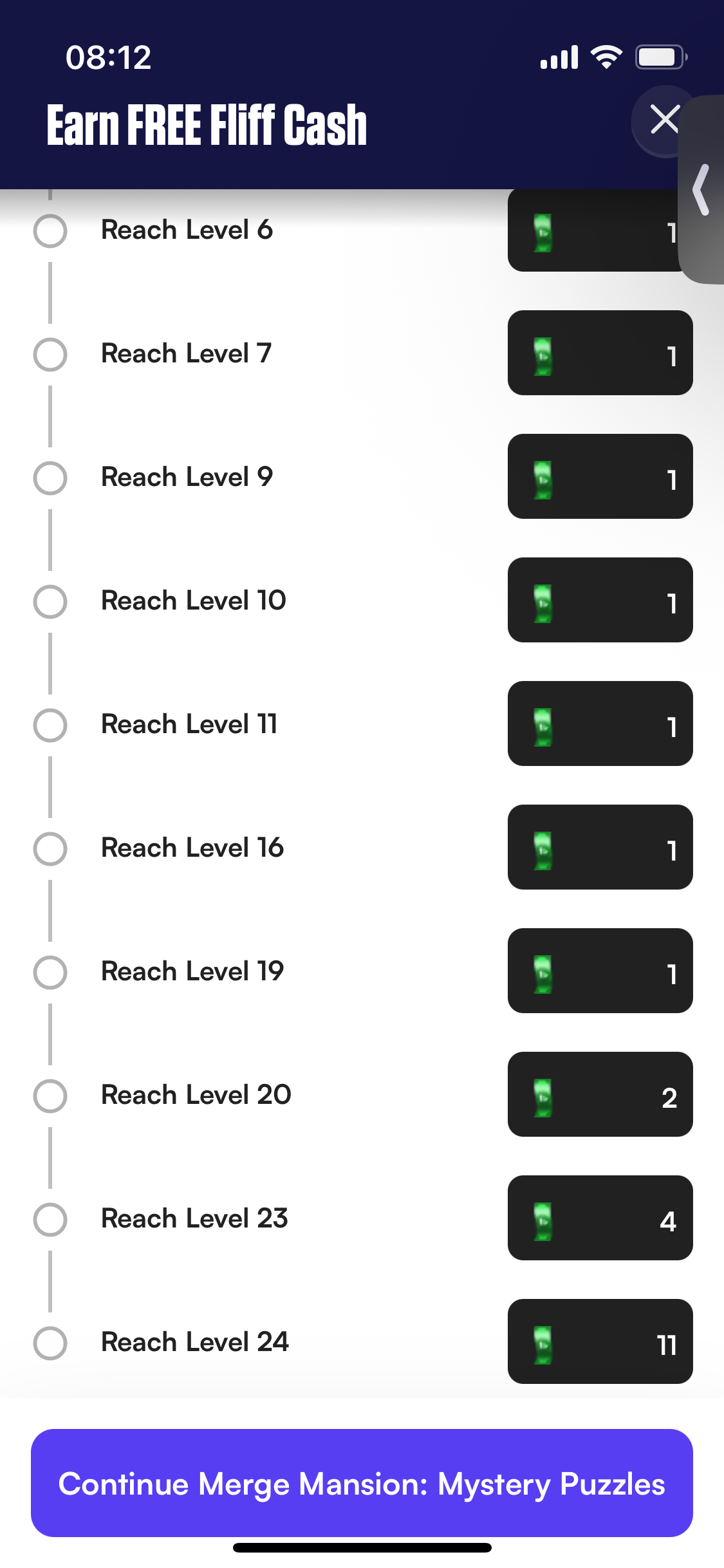
They also had a scheme called Cash Quest where you can download other apps and achieve goals and you would be given more Fliff Cash.
This was the main route I used to gain money from the app. Mainly just downloading random games and playing them a bit and gaining a bit of cash for it. It was a fascinating introduction to the pay to play game app industry.
I learned all about Scopely (a mobile game developer that just pumps out addictive pointless games with tons of lottery, gambling, and lootbox mechanics, that efficiently exploit whales into a ton of microtransactions, all for nothing really) and other “creators” who just prey on people from their pockets.
Some of these apps are brutally effective, with so much color and animation that they clearly are pummeling children and adults alike with to keep them glued to their phones and these predatory economic ecosystems they’ve manufactured. They have a bajillion pop ups, and are optimized to keep rewards just out of reach, with ever escalating and endless challenges.
Others were just overly garbage. Just the most incredible drivel, a pile of slop. I couldn’t believe someone actually spent time building it.
It made me appreciate “real” games much more. Purchasing a great game for a set one time price and playing it to completion, just buy learning and getting better at it versus the exploitative tactics to separate users from their real money that these free-to-play games require you to actually pay to progress, but I digress.
I mainly got the funds from Mancala, Travel Town, Merge Mansion, and Woodblock Jam. The other games I found far too nauseating, difficult, stupid, or otherwise not worth the effort.
Monopoly Go was absolutely crazy to experience. It was a quick few bucks (but not a lot), but it was an insane ride that amazingly had nothing to do with Monopoly other than vaguely the IP. It was the worst offender of this realm of games.
Mancala ($35) was my favorite since you actually just played Mancala which was quick and easy, and the AI was never particularly smart.
Woodblock Jam ($20) was a genuine puzzle game which I found challenging, except for a very difficult timer that made the game significantly less enjoyable.
Travel Town ($40) and Merge Mansion ($25) were silly mindless daily games, that were quite relaxing and enjoyable for a person with a knack for incessant useless organization.
You’d then have to bet all the Fliff Cash to make them withdrawable.
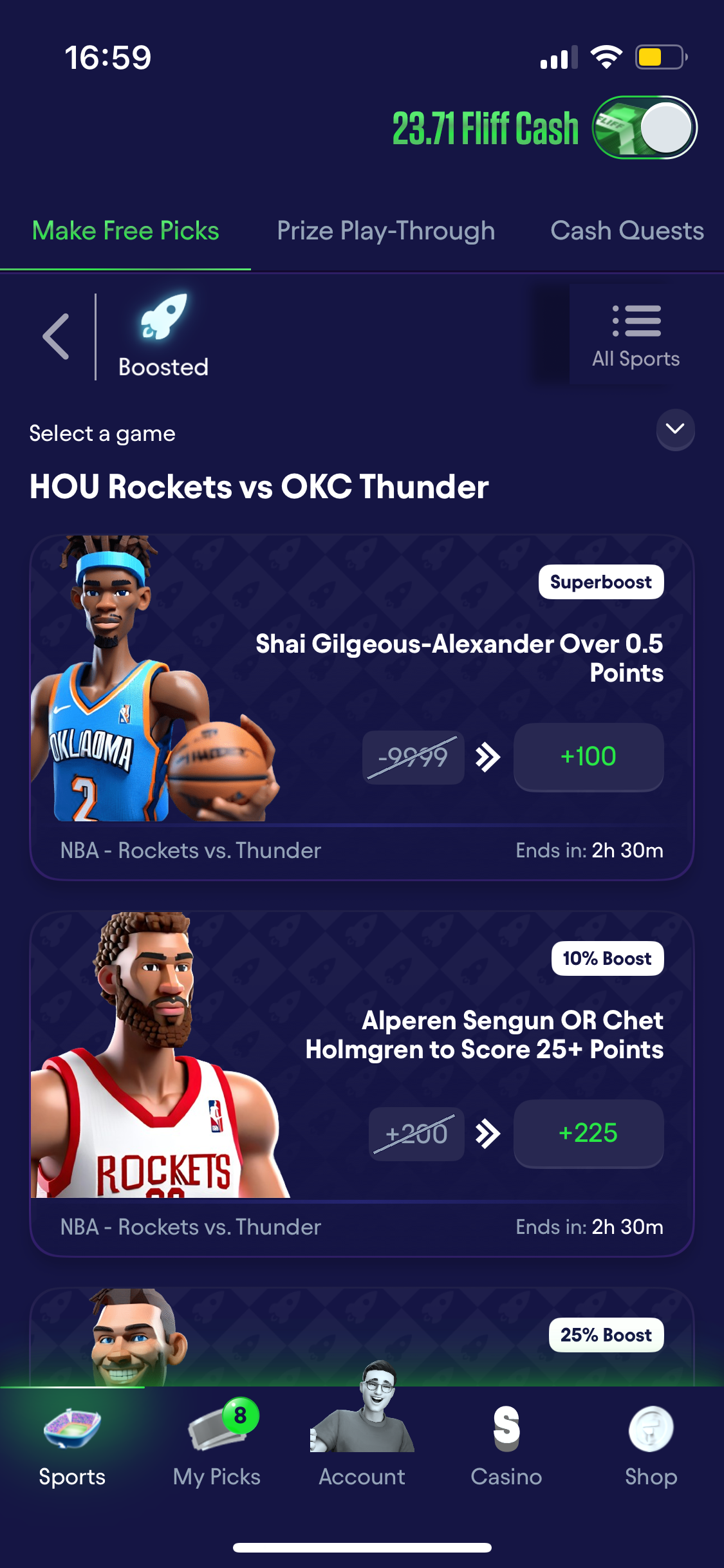
Very rarely there would be a bonus free bet too, like this NBA bet to kick off the season. You can see this as basically automatic free money offer. It was capped at a $5 bet.
Fliff Coin
This is the main bread and butter of the app. It’s a fictional currency that is worth nothing. You get 1,000 coins every 2 hours, you just have to click and get it. However there is no redemption value for them. You literally just bet and win and lose with no real repercussions. It feels slightly good to correctly predict a result and win and I feel nothing if I lose. Which is great.
The predatory aspect is that they offer the ability for you to buy coins. Which is crazy. No one should ever be purchasing these useless coins, especially since they’re free regardless, since they offer you another 1,000 every 2 hours.
This is pretty safe to allow someone to learn what sports gambling is and how hard it is (especially if you keep in mind that the odds here are worse than normal sportsbooks and therefore you’re more likely to lose and it could be a nice way for them to learn that it isn’t so easy)… as long as they don’t spend money to get coins. I personally would be interested in giving someone the chance to try as long as there were guardrails up, and use it as a low risk learning experience.
New York actually has banned this, so you can’t actually buy the Fliff Coin, so that’s a positive, but I’m assuming if it exists in the app, there are other states that allow it.
Experience Points
Daily Fliff offers 15 Experience Points if you do 5 achievements (with some bonuses here and there). The challenges are typically “bet on these games” and get a couple experience points. This acts as a sort of, preview of what today’s sporting events are. I genuinely found it helpful to follow sports that I don’t typically pay attention to. I watched more baseball, basketball, soccer, hockey, and football this year, simply because I was more aware of good matchups.
If I were Fliff (or any sports betting app), I would add a tab where I could add teams that I follow and whenever their games pop up they would all be in one tab so I could always bet on the ones I want to watch.
Sports gambling and Sports really do go hand in hand. The engagement of both increases the other. This synergy is definitely true and I’ll miss it now that I’ve cut it off.
So these experience points simply add up over time and can be redeemed for gift cards. There’s a minimum balance before you can actually redeem it, but just save them and eventually you’ll hit it and can cash out.
Yes, it’s all awful.
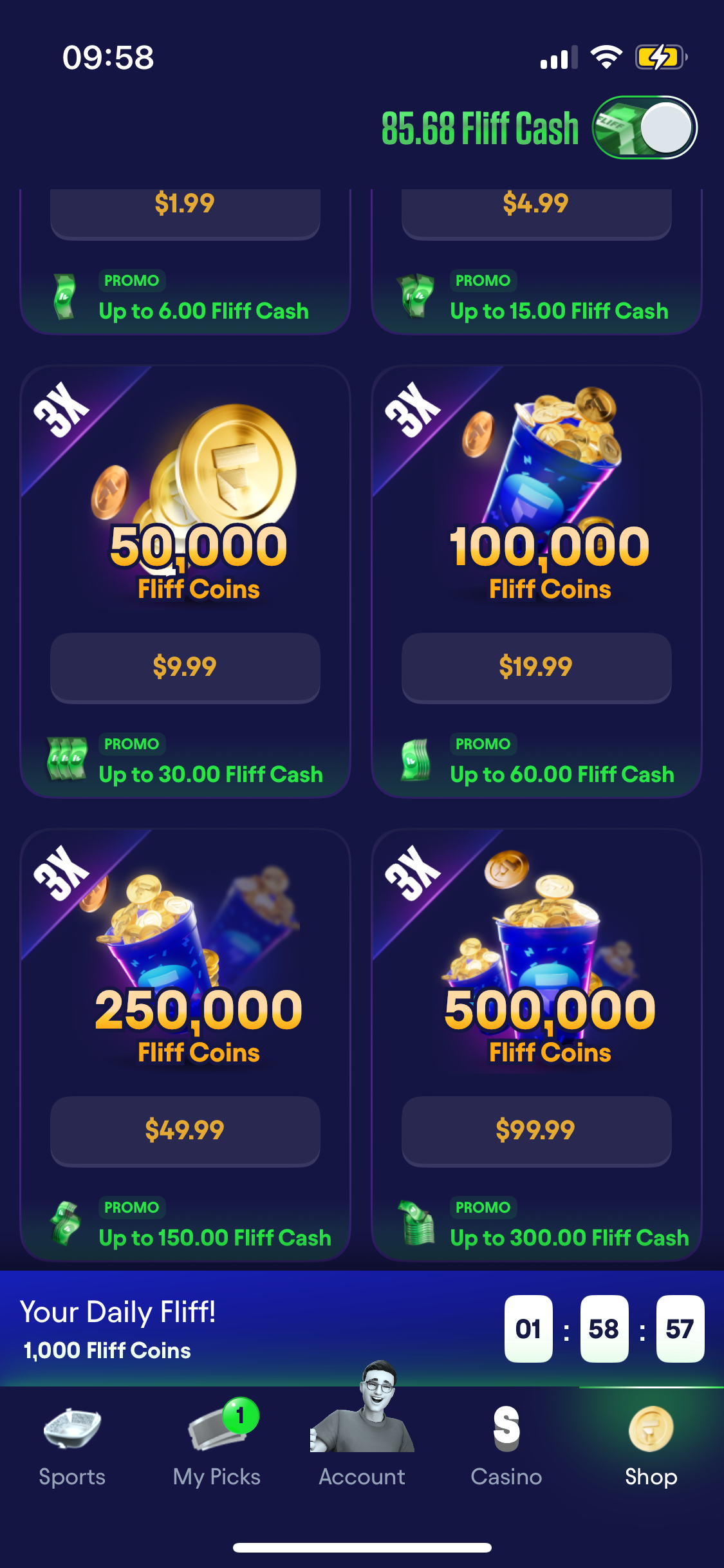
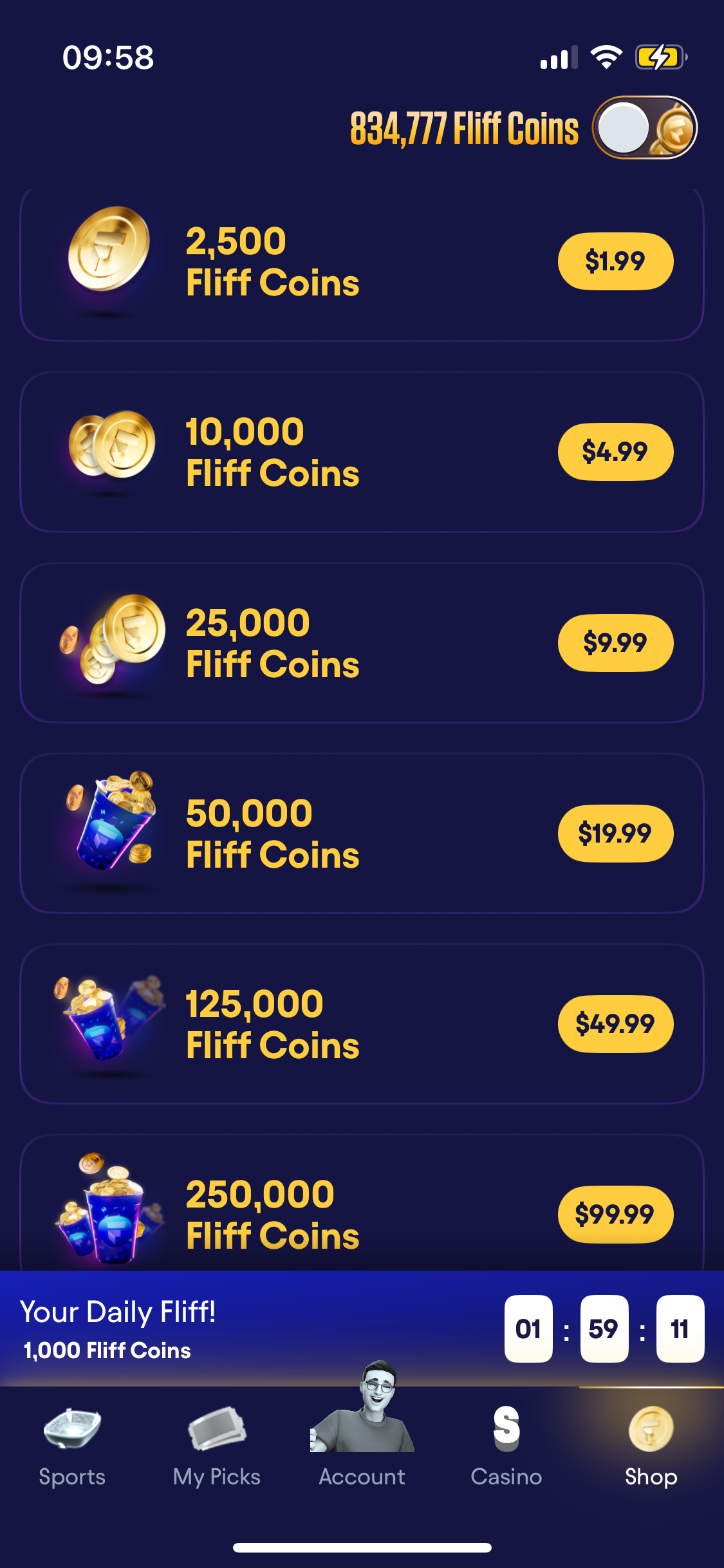
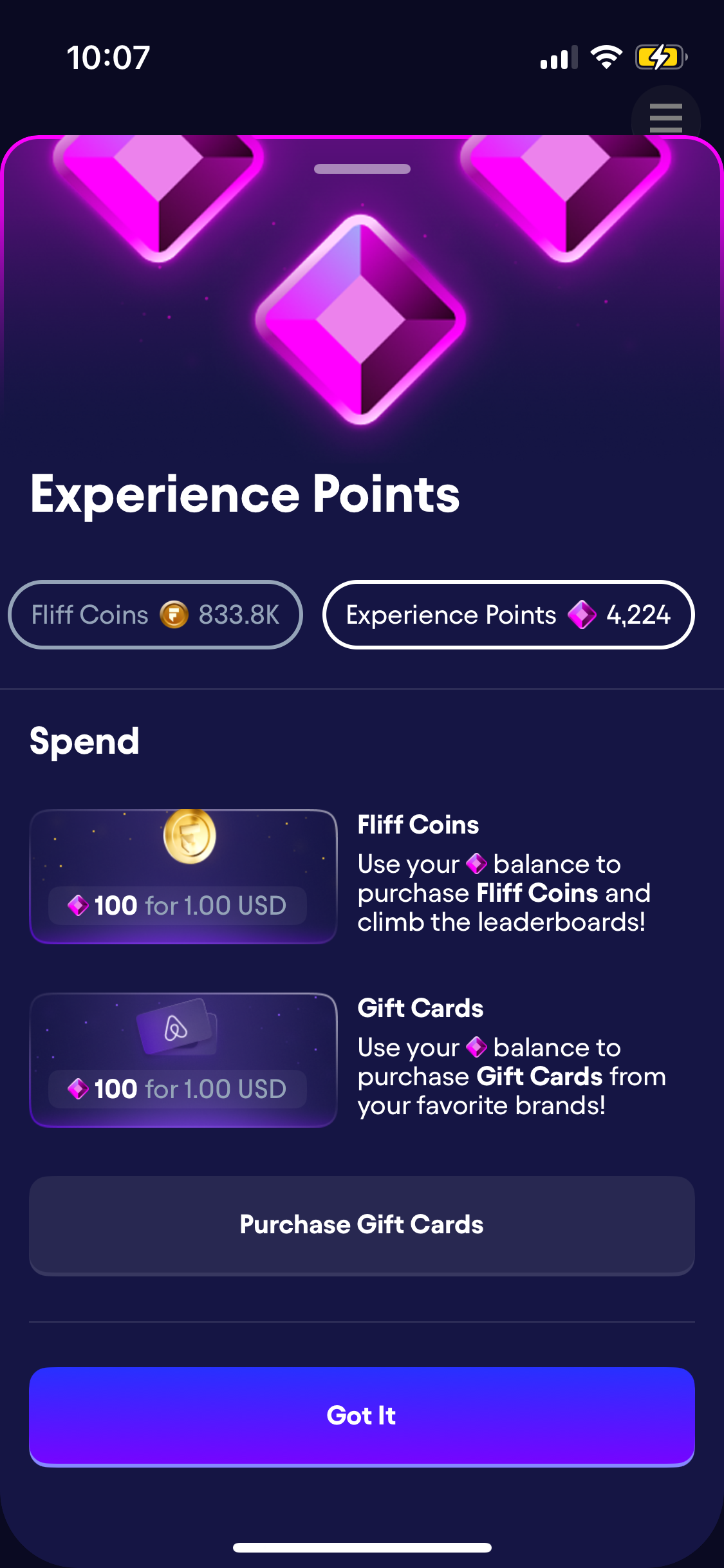
There’s also a social element, that you can interact with friends. And a level system, that doesn’t seem to have a lot of clarity as to how you’re ranked or how you get promoted or relegated.
Result of Nine Months of Fliffing
I earned:
Fliff Cash
I peaked around $150 through a combination of those Cash Quest games and betting on sports. However, in a strange combination of boredom, knowledge of my decided planned exit from the app, and a surprise access to the Fliff Casino when I was in Connecticut, I lost it all…
Apparently, there is a Fliff Casino area of the app that was unavailable in New York, but available in Connecticut and I stumbled upon it. Here there were just straight up gambling games like Blackjack and Roulette, but also some random more slot like games like Plinko and Dice.
So, in this reckless state, enabled by Connecticut’s flexibility, I figured it would give me a real and safe opportunity to try the James Bond roulette strategy and Martingale betting strategy.
Quickly, the James Bond roulette strategy is a method to spend 20 units on a single spin:
14 on either High or Low
5 on a double street bet (six numbers) on the area you didn’t cover with the first 14
1 on zero (green)
This covers 25 / 37 numbers or about two-thirds of the options (depending on the roulette wheel). And you would be profitable if it hit any of those numbers. However, it should be noted that the expected value is still negative, since the house edge is 2.7% and will always in the long run beat you.
The Martingale strategy is basically to double your bet when you lose to try and gain back your losses quickly on the next round. It’s inherent flaw is that it can bankrupt you quickly. If you keep doubling, within a few rounds, you’ll run out of funds.
It turns out the Fliff Casino, like the rest of the betting app does not provide the same standard odds as a typical casino, and this would additionally hurt my chances. Also, it’s janky and wonky format makes it harder to track and confirm the history. I definitely switched the 14 unit and 5 unit bet with a 15 unit and 4 unit bet multiple times by dyslexic accident.
So I started with a $2 bet ($1.40 on High, $0.50 on 13-18, and $0.10 on 0) and played a few rounds to a slight profit. Then proceeded to lose 7 times in a row (and doubling my bet) effectively bankrupting me within a couple minutes. Here’s a schedule of basically what happened. And let this be a warning to anyone who is considering gambling. The house always wins, and you truly should never gamble anything you aren’t okay with losing.
| Round | Total Wager | Bankroll |
|---|---|---|
| $150 | ||
| 1 | $2 | $148 |
| 2 | $4 | $144 |
| 3 | $8 | $136 |
| 4 | $16 | $120 |
| 5 | $32 | $88 |
| 6 | $64 | $24 |
| 7 | $128 | -$104 |
Fliff Coin
I’ve somehow amassed 800K. Again, they’re worth nothing, so it doesn’t really matter.
Fliff Experience Points:
I earned 4,714 experience points which equated to a $47.14 gift card to Chewy.
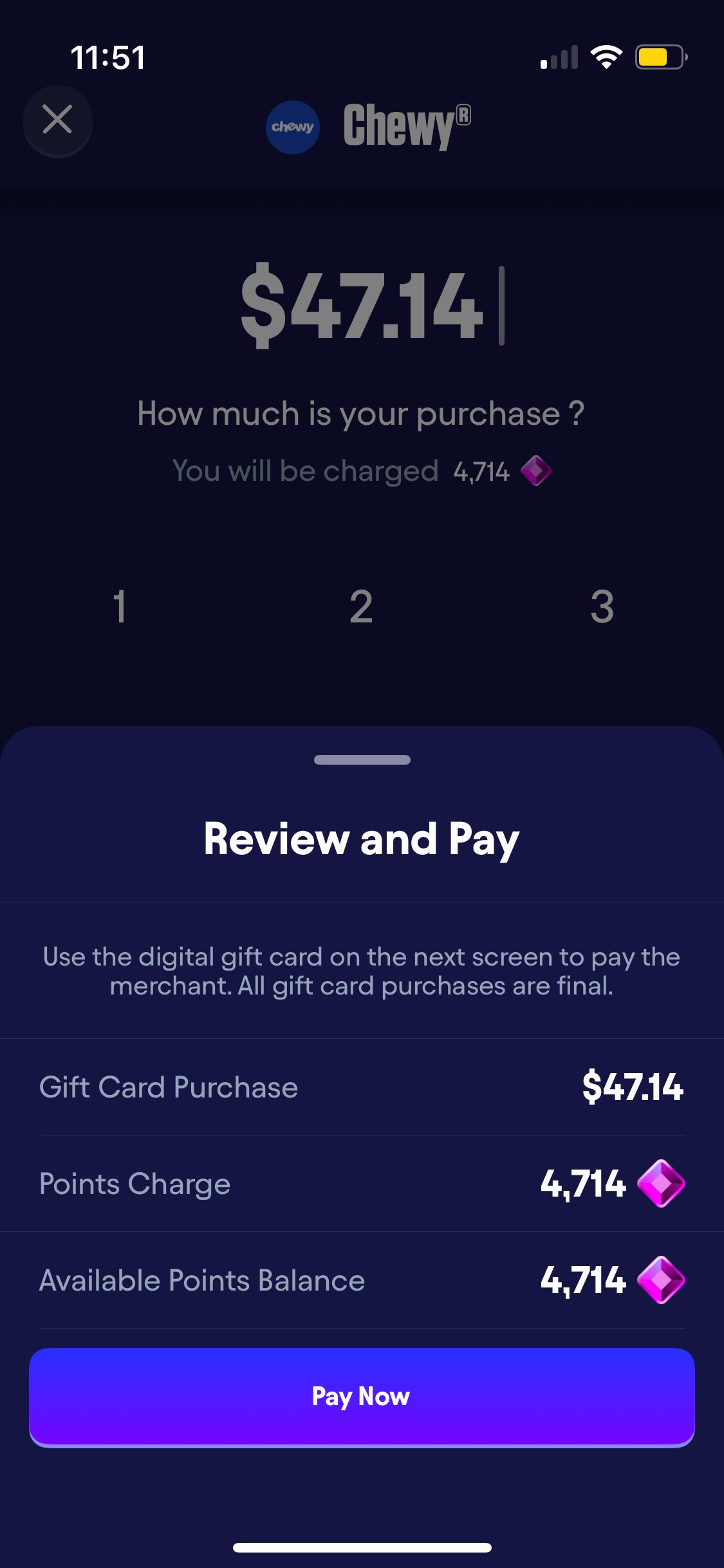
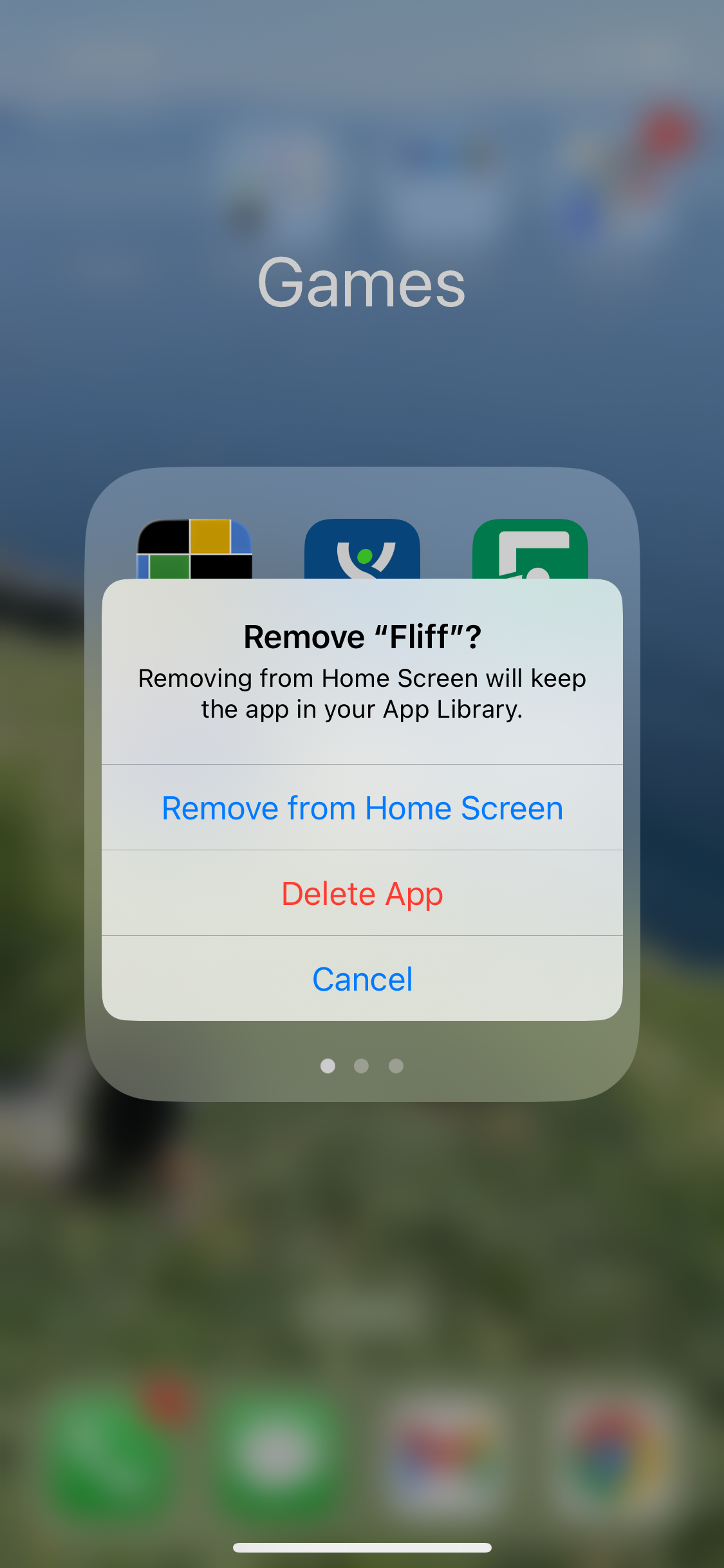
And with that. Deleting Fliff for 2026. It’s been a weird ride. Mostly a waste of time, but there were some enjoyable moments.
Mobile Gambling and Sports Gambling
With the advent of mobile gambling available at your fingertips all the time, the chances you are willing to gamble irresponsibly increase greatly, because eventually circumstances and your mindset will unfortunately align. Very quickly you can lose a lot. The designed trend towards immediate gratification often hurts typical users. I’m a relatively intelligent person, with decently strong willpower, and suddenly before I truly realized it, I had squandered $150 in mere minutes and had little to nothing to show for this blog post. I’m lucky that I had spent zero dollars on the app (though I had spent a great deal of time earning those funds) and followed my rule of not adding any additional funds to try and dig myself out of a spiral. Most other attempts at gambling at casinos have also had that “full tilt” feeling where I want to add funds to just dig myself out. And it’s difficult to simply wallow in the misery and let myself be mad at myself. I attempted to distract from the feeling with some manual labor (shoveling snow) and afterwards “unhealthily” with a tasty snack and a distracting movie (Jay Kelly on Netflix).
Many people, young men in particular, suffer from this easy access to gambling. I know I have an addictive personality, and clearly a spark of random base urges can drive me into making poor decisions that most of the time I would not make. And yet, here we are. I’m not immune. I see the hopes of gambling. I feel the FOMO of what could be, and the embarrassment of sharing with others my stupidity. Strictly limiting my funds and reducing my access to these apps is the best way I know how to control this risk. I’m sure there are plenty of people who do have control over it, and can do it healthily (in fact for 9 months, I did, betting only the minimums and being responsible), but for me, the grinding and allure of a shortcut caught me out. I am very fortunate to be able to weather this shortcoming and it will have zero effect on my financial state, but not everyone will be so lucky.
This predatory business needs to be curtailed significantly. The increase in engagement and viewership is not worth the genuine risk to personal finance that these apps have become synonymous with. I’m sorry if audience ratings drop and valuations subsequently drop too, but this is not going to end well otherwise. The government needs to get involved. This experiment is going poorly and needs to be reevaluated. Maybe at the very least just get it off our phones. Maybe if there was a social aspect and had some physical barriers, at least it would slow down the process and provide some necessary friction to prevent the worst case situations and even boost local economies as well.
If you’re reading this and are in, near, post, or pre a tilt, please just walk away and take a breather. Remember the odds, and how they’re not in your favor. Recognize that this system is designed to extract money from you. Think of what you could do with the money instead. Know that while, it’s significantly more boring and less exciting, it will feel better to not lose money than to lose money. If you know someone struggling, hopefully you can support them and have some understanding for their situation.
Take this nine question survey to see if you have a problem. I just took it and I think the scoring is a bit unfair. I apparently qualify as Problem Gambling, the highest category, because I scored an 8… which feels vastly different than a maximum score of 27, but hey, I’m not the expert, perhaps I really am in the same category as someone who scores a 27. Either way, acknowledgement is the first step.
Score of 0: Non-problem gambling.
Score of 1 or 2: Low level of problems with few or no identified negative consequences.
Score of 3 to 7: Moderate level of problems leading to some negative consequences.
Score of 8 or more: Problem gambling with negative consequences and a possible loss of control.
Here’s a link to the New York State support center. Problem Gambling | Office of Addiction Services and Supports
With that, best of luck, I’m off to spend my gift card to Chewy, because we’ve decided to adopt a cat. Different kind of gambling.